
Did it work? The 14 day check, and what each result means
Fourteen days after publishing, compare the same four numbers against your baseline. Three outcomes, three different next moves, and what this check cannot tell you.

Here is how to tell if an SEO change worked: fourteen days after publishing, compare the same four numbers you recorded before — clicks, impressions, CTR and average position — and read the result against three possible outcomes, each with a different next move. Fourteen days is long enough for a recrawl and short enough to still remember what you changed. The comparison only works if you took a baseline; if you did not, this step has no answer to give you.
Read this first
You need the before you saved when you recorded your baseline, and the exact publish time. Compare identical windows — a 3-month before against a 2-week after is not a comparison, and it is the single most common way people convince themselves something worked.
How to tell if an SEO change worked, and why fourteen days
Google's own estimate is that indexing "typically takes only a day or so, but can take much longer in some cases". Being recrawled is not the same as being reassessed, and position readings in the first week swing hard on small impression counts. Checking on day three tells you about noise.
Daily checking is not measurement. It is anxiety with a dashboard.
The comparison table
Pull the same two Search Console views you exported before — the target term, and the whole page — for the 14 days after publishing, and the equivalent 14 days before. Fill this in.
| Metric | Before | After | Read it as |
|---|---|---|---|
| Impressions | — | — | How often you were shown. Moves first. |
| Average position | — | — | Where you sat. Moves second. |
| CTR | — | — | Whether the title earned the click. |
| Clicks | — | — | The only one that is actually traffic. |
| Cited in AI answers | — | — | Re-run the same fixed prompts from the baseline. |
Also re-run the crawler-view fetch from the baseline step and compare byte counts. If the page changed visibly but the raw HTML barely moved, the crawler never saw your edit and every number above is measuring the old page.
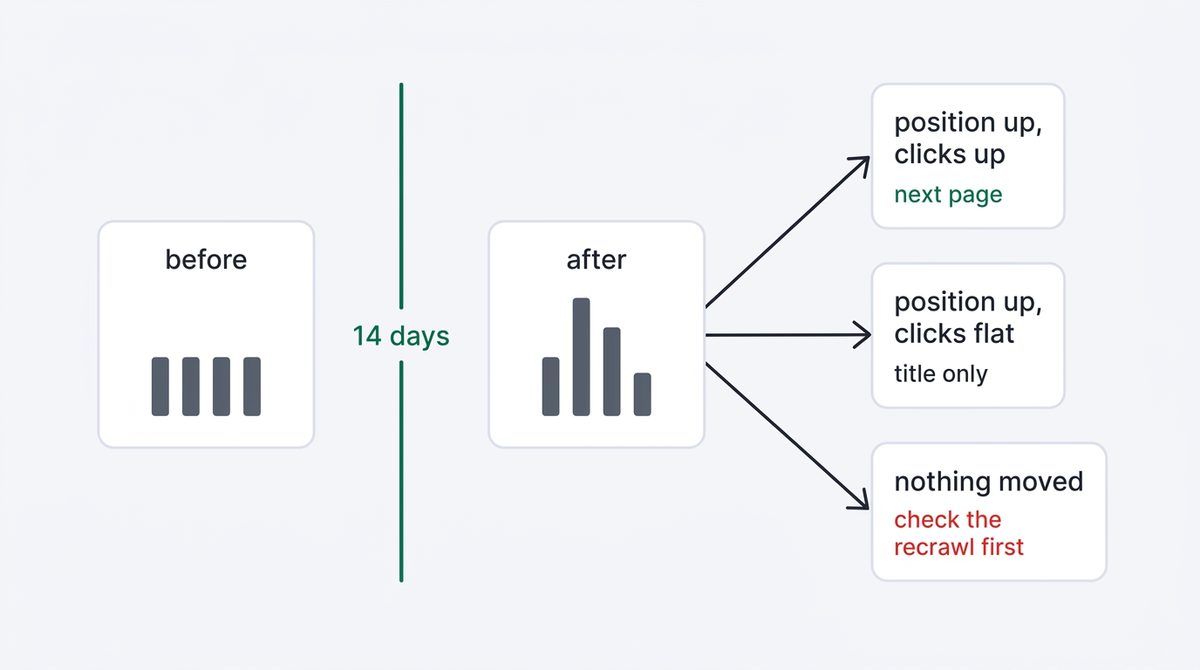
Three outcomes, three next moves
Almost everything lands in one of these. Find yours and do the matching thing — the point of a defined check is that the answer is decided in advance, not negotiated afterwards.
| What you see | Means | Next |
|---|---|---|
| Position improved, clicks up | It worked | Do the same eight edits to the next page. Do not keep polishing this one. |
| Position improved, clicks flat | Ranking better, still not chosen | Title and description only. Leave the body alone and re-check in another 14 days. |
| Impressions up, position flat or worse | Showing for more searches, none of them well | Intent mismatch. Check which terms appeared — you may be drifting toward a search this page cannot win. |
| Nothing moved at all | Often not a content result | Verify the recrawl happened before concluding anything. No recrawl means no result yet. |
Read impressions before position
Impressions answer a different question from position, and reading them in the wrong order is how people misdiagnose a good result as a bad one. Impressions tell you how often Google chose to show you at all. Position tells you where you sat when it did.
A page that gains impressions while its average position drifts down is usually winning, not losing: it has started appearing for a wider set of searches, most of them ones where it ranks lower, which drags the average. The same numbers on a page whose impressions are flat mean something much worse. Neither reading is available from the position column alone, which is why the table above has both.
What this check cannot tell you
It cannot prove causation. Fourteen days of one page is not an experiment with a control group; rankings move for reasons that have nothing to do with you. What it gives you is a defensible before-and-after on one change, which is enough to decide what to do next and not enough to publish as a finding.
It also tells you very little about AI answers. Search Console reports Google Search. The prompt re-run from your baseline is a handful of observations, not a measurement — treat a change there as a hint worth following, not a result.
Three ways this goes wrong
Each one produces a confident conclusion from data that does not support it, which is worse than having no conclusion.
- Comparing unequal windows. Fourteen days against three months makes every change look enormous or invisible depending on which way you hold it.
- Reading position without impressions. An average position that improves while impressions collapse usually means you stopped appearing for the hard searches, not that you got better.
- Changing the page again mid-window. Then you have two changes and one measurement, and the fortnight is spent.
Common questions
Nothing moved. Was the rewrite wasted?
Not necessarily, and check the recrawl date before you decide. A page that was never recrawled has not been assessed. If it was recrawled and nothing moved, the honest reading is that this particular change was not the constraint on this particular page.
Should I extend to 30 days?
If the page has few impressions, yes — thin data needs a longer window. Decide the window before you look, not after you see a number you dislike.
How do I check whether AI answers changed?
Re-run the same prompts you used at baseline, unchanged, and save the answers next to the old ones. Same wording, same engines. Changing the prompts makes the pair worthless.
Next step
You have now run the whole loop once: found a search worth chasing, recorded a before, rewrote a page, pushed it for indexing, and read the result. That is the entire method — everything after this is doing it more often, on more pages, and knowing when a step does not apply.
Doing this by hand for one page takes an afternoon. Doing it continuously across a site is the job QueryWin is being built to take over.
Part of the QueryWin handbook · Level 1