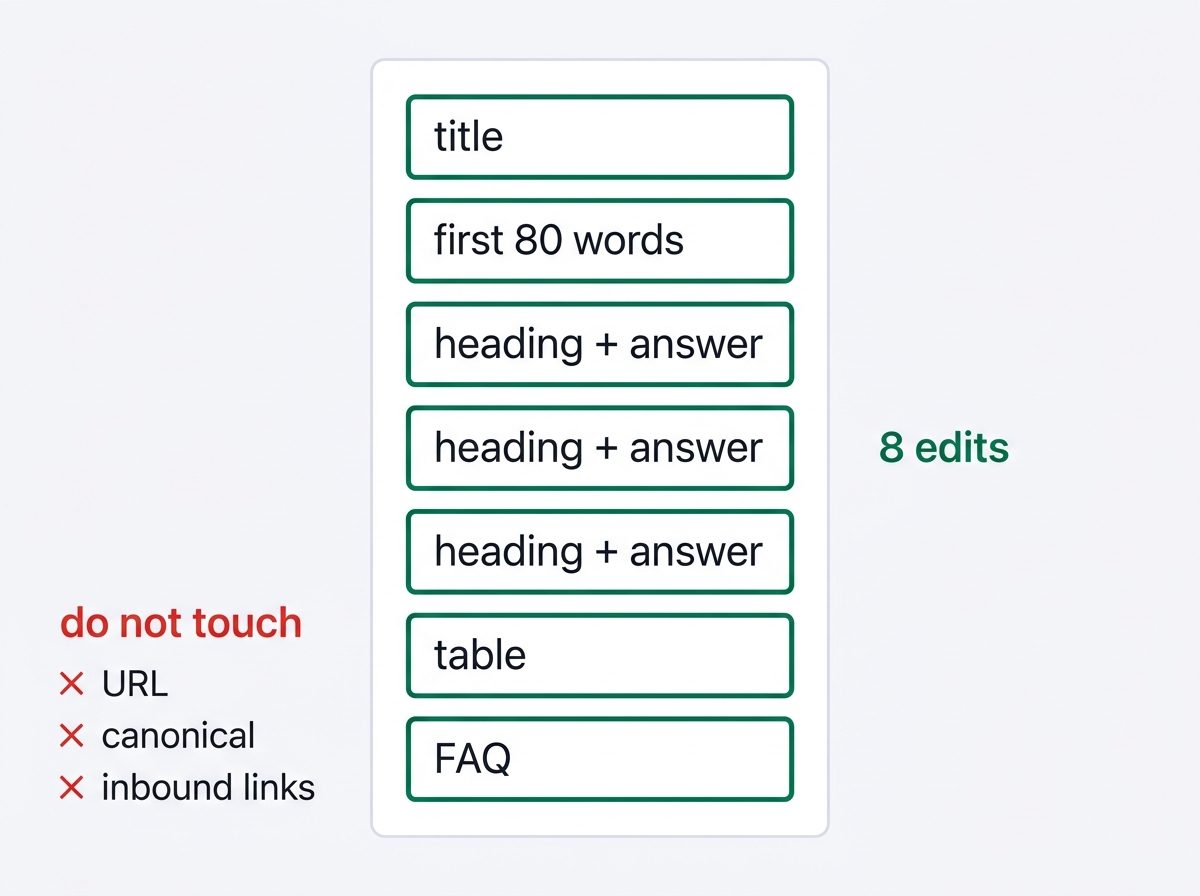
A rewrite worksheet for one page: eight edits, three things not to touch
A rewrite worksheet for one page: forty minutes, eight ordered edits, and three things that must not change. Includes what Google says about editing dates.

This is an SEO rewrite checklist for one page: forty minutes, eight edits, and three things you must not touch. It assumes you already know the search term you are chasing and have recorded a baseline. The point is a deliberate change you can later attribute — not a general tidy-up, which is untestable and usually loses more than it gains.
Read this first
Two things must already exist: one target search term from striking distance keywords in Search Console, and a saved before. If the baseline is missing, stop and record it now — after this edit, the before is unrecoverable.
🚫 Three things not to touch
Change these and you are no longer running an experiment, you are running a demolition. Each one can cost rankings the page already has.
| Do not change | What breaks |
|---|---|
| The URL | You reset the page's history. If it truly must change, that is a redirect project, not a rewrite. |
| The canonical tag | Points Google at a different page. Silent, and it removes this one from results. |
| Links pointing in from other pages | Those references are why the page ranks at all. Rewriting the body does not touch them; deleting sections often does. |
A rewrite changes what the page says. The moment it changes where the page lives, it is a different job.
The SEO rewrite checklist, in order
Work top to bottom. The order is deliberate: the first two produce most of the effect, so if you run out of time you have still done the part that matters.
- Rewrite the first 40–80 words into a direct answer. No preamble, no restating the question. If you cannot write it, the page has no answer yet and that is the real finding.
- Put the target search term in the title, as early as it reads naturally. Natural beats early. A title that reads like a robot wrote it loses the click you were trying to win.
- Turn each heading into the question a reader would type. "Overview" and "Background" are wasted slots.
- Give every heading a direct answer as its first paragraph. Then expand underneath.
- Convert one comparison or threshold into a table. Most pages have one buried in prose.
- Add a short FAQ using real search wording. Three to five. Take the phrasing from autocomplete or People Also Ask, not from your imagination.
- Add one limit or caveat you actually believe. Where this does not apply, or what you do not know.
- Check every claim still has a source or a number. Rewrites tend to sand off the specifics that made the page worth reading.
🚫 What not to do to the date
Do not change the published date to make the page look fresh. Google names this behaviour directly in its guidance on creating helpful content, in the list of things that signal content made for search engines rather than people: "Are you changing the date of pages to make them seem fresh when the content has not substantially changed?"
If the content did substantially change, updating a modified date is honest and useful. The problem is the date moving on its own.
Where the forty minutes actually goes
Most of it goes on edit one. Writing a direct answer to a search term, in eighty words, with no run-up, is genuinely hard — it forces you to decide what you actually think. Edits three through eight are mechanical by comparison and rarely take more than twenty minutes together.
If you find yourself an hour in and still rewriting the opening, that is not a sign you are doing it badly. It usually means the page never had a clear answer, and you are now discovering that. Finish the opening; the rest will be quick.
Before you publish
Read the finished page against these four. Any no means go back.
- Does the opening 40–80 words answer the search term on its own, with no setup?
- Can you pull any single heading plus its first paragraph and still have a true, complete statement?
- Is every number still attached to a source or a date?
- Did the URL, the canonical and the inbound links survive untouched?
Three ways this goes wrong
The first is by far the most common and the most expensive.
- Rewriting the whole page instead of eight edits. A total rewrite changes so many variables at once that the after tells you nothing about which change did it — and it usually deletes the specific details that were the page's only advantage.
- Optimising a page whose intent does not match the search. No amount of restructuring makes a product page win an informational search. If the mismatch is real, the answer is a different page.
- Publishing without noting the time. The dividing line between before and after is the publish timestamp. Without it you cannot read your own data in two weeks.
Common questions
How much of the page should change?
Enough that a reader would notice the answer arrived sooner. In practice that is often under a third of the text, concentrated at the top.
Should I add word count?
No. Length is not the lever, and padding pushes the answer further from the top, which is the opposite of the goal.
Can I do several pages at once?
You can, but then you have one experiment with several variables. For the first pass, do one page and see the mechanism work end to end.
Next step
The page is edited and the publish time is written down. Publishing is not the end though — a change nobody has crawled is a change that has not happened yet, and that gap is where most sites quietly lose their fortnight.
Editing the page is the visible half. Getting it published and pushed for indexing is the half that decides whether any of it counts.
Part of the QueryWin handbook · Level 1