
Striking distance keywords: the Search Console filter and what to fix first
Striking distance keywords are search terms where you already rank 5 to 15. Here is the exact Search Console filter that lists yours, and the rule for which one to fix first.

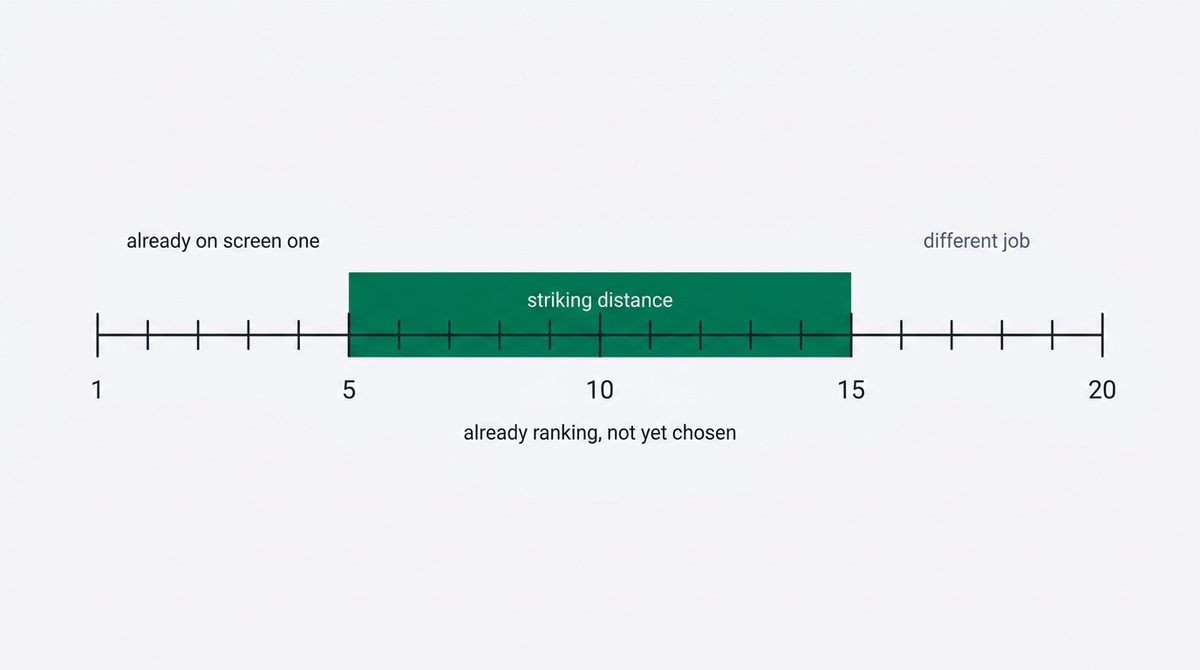
Striking distance keywords are the search terms where you already rank between about 5 and 15 — on the board, off the first screen. They are the cheapest wins you own because the hard part is done: Google already considers the page a reasonable answer. Search Console lists them for free, and this chapter is the filter plus the rule for deciding which one to fix first.
Read this first
This chapter needs a verified Search Console property with at least a few weeks of data. It also assumes AI crawlers can reach the pages you are about to work on — if you have not checked, that is how to check if AI can read your site, and it takes two minutes.
What striking distance keywords are, and why they are cheap
A search term you rank 40th for needs a different page, more references, and months. A search term you rank 9th for usually needs a better answer to a question you are already half-answering. Same effort, wildly different odds, and Search Console already knows which is which.
Do not go looking for search terms you deserve to rank for. Fix the ones you already almost rank for.
The exact Search Console filter
Open the Performance report, then set it up in this order. The order matters because each step shrinks what the next one has to load.
- Date range: last 3 months. That is Search Console's default view — it shows "click and impression data for your site in Google Search results for the past three months". Shorter windows are noisy; longer ones hide that a term is already moving.
- Switch to the Queries tab and turn on all four metrics: clicks, impressions, CTR, average position.
- Filter position greater than 4.9 and less than 15.1. Below 5 you are already on screen one; above 15 you are on page two or worse and it is a different job.
- Filter impressions greater than 100 over the window. Under that, the position figure is averaged over too few events to trust.
- Sort by impressions, descending. Export the table.
What comes back is a list of searches where real people already saw you and did not click, or clicked rarely. That is the whole raw material.
What average position actually means
This trips up almost everyone, and it changes which rows are worth your time. Search Console defines average position in the table as "the average position in Search results for the specific URL or grouping dimension shown in the table row" — and in the chart as the average of "the topmost result from your entire site".
Two consequences. A term sitting at 8.4 was probably never at 8.4 in anyone's actual results; it may have been 4 for half the impressions and 13 for the other half. And because it takes the topmost result, a term where two of your pages compete shows you the better one and hides the fight. That second case is a real problem with its own fix, later in the handbook.
Which one to do first
Sorting by impressions alone sends you to the biggest term, which is usually the hardest. Score each row instead. Rank by the top box that applies and stop.
| Priority | Looks like | Why it is first |
|---|---|---|
| 1 | Position 5–10, high impressions, CTR far below your site average | You are visible and being skipped. Usually a title and opening problem, not a content problem. |
| 2 | Position 8–15, impressions rising month over month | Already moving. A push here compounds with whatever is already working. |
| 3 | Position 5–15 on a term that describes what you sell | Fewer impressions, but the clicks are worth more. Commercial intent beats volume. |
| 4 | Position 11–15, flat, informational | Real work for real but slow gains. |
| 🚫 | Position 5–15 but the search means something else | Skip. You cannot win a search whose intent your page does not match. |
Take one row from priority 1. One. The rest of the handbook is about doing that one properly.
Three ways this goes wrong
All three feel productive and produce nothing.
- Exporting 400 rows and starting a spreadsheet. The list is not the deliverable, the fixed page is. A list you never work through is indistinguishable from not having looked.
- Chasing the biggest impression number. The largest term in your export is usually the one where the results are owned by sites with a decade of references. Priority 1 exists precisely to keep you off it.
- Treating brand searches as wins. People searching your own name were always going to find you. Filter them out before you decide anything, or you will conclude everything is fine.
Common questions
Why 5 to 15 rather than some other range?
It is a working band, not a law. Above 5 you are already visible and gains get expensive; past 15 the gap is usually structural rather than a matter of rewriting. Move the edges if your own data says something different — the point is to work a band, not the whole export.
My CTR is low but position is 3. Is that striking distance?
No, that is a different problem and a better one to have. At position 3 the fix is almost always the title and the description, not the page.
Does this work for AI answers too?
Partly, and be careful here. Search Console reports Google Search, so this filter finds Google opportunities. Being a strong Google result raises the odds of being used in AI answers because several engines draw on search indexes, but Search Console will not tell you whether you were cited. Measuring that is a later chapter, and it is harder than it sounds.
Next step
You now have one search term, one page, and a reason. The next question is what actually makes an answer worth citing rather than merely relevant, because rewriting for that is what moves a position 8 to a position 3 — and it is the same work that gets a page quoted in an AI answer.
Finding the term is the free part. Rewriting the page, publishing it and pushing the update for indexing is where most sites stall.
Part of the QueryWin handbook · Level 1