
What makes content citable by AI: the extract test and seven fixes
What makes content citable by AI is whether one passage can be lifted out and still be true on its own. Here is the test, seven fixes ordered by effect, and the same claim written twice.

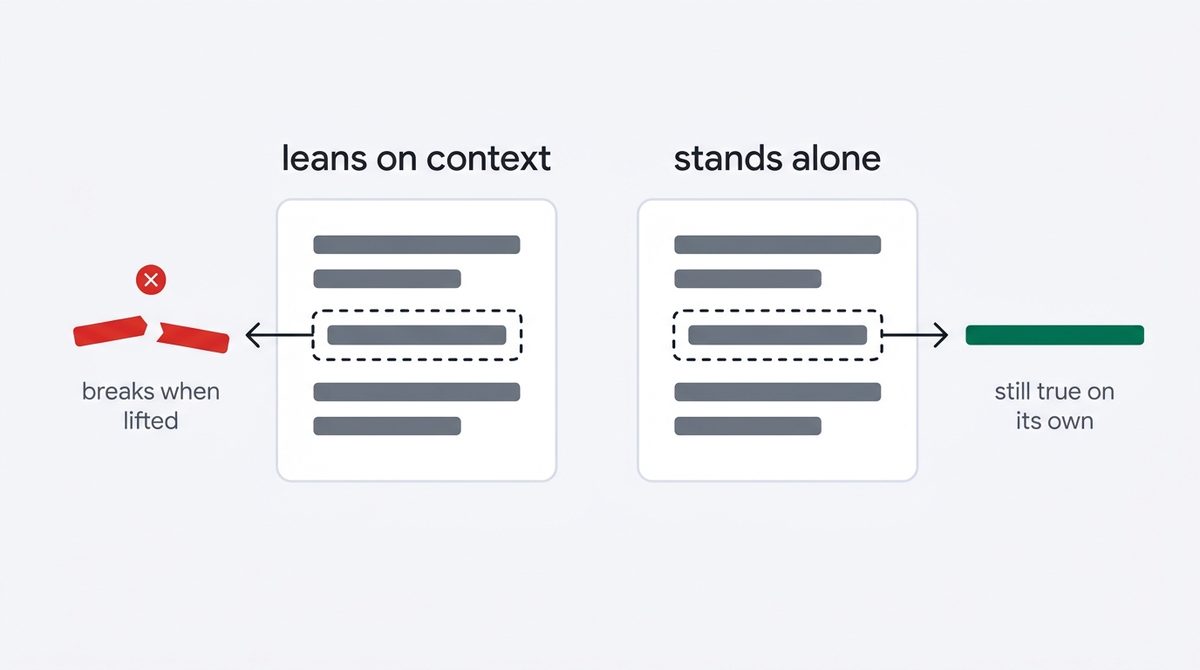
What makes content citable by AI is not quality in the abstract — it is whether a single passage can be lifted out and still be true, specific and attributable on its own. An engine composing an answer needs a sentence it can stand behind without the surrounding page. Most writing fails that test not because it is bad, but because every sentence leans on the one before it.
Read this first
This chapter assumes you have picked one page and one search term to work on. If you have not, striking distance keywords in Search Console is where the term comes from. It also assumes crawlers can actually fetch the page — a beautifully quotable paragraph nobody can retrieve is worth nothing.
The test: does the sentence survive being taken out
Copy any sentence from your page. Paste it somewhere with no context. Is it still a complete, checkable claim? If it needs the paragraph above to make sense, an engine has to either quote the whole section or skip you — and it usually skips you.
Write so that any single sentence can be stolen and still be right.
What makes content citable by AI: seven fixes
These are ordered by how much they change your odds, not by effort. The first three do most of the work.
| # | Do this | Because |
|---|---|---|
| 1 | Answer in the first 40–80 words, before any setup | That block is what gets lifted. Background first means the answer is too deep to reach. |
| 2 | Give every sentence its own subject | "It does this" is unquotable. "GPTBot does this" survives extraction. |
| 3 | Attach a number, a date or a named thing to each claim | Specific claims are checkable, and checkable claims get reused. |
| 4 | Define each concept once, in one self-contained sentence | A definition that stands alone is the single most-quoted shape on the web. |
| 5 | Put comparisons and thresholds in a table | Structured facts extract cleanly; the same content in prose does not. |
| 6 | Use the reader's actual words as headings | Matching the question makes the section findable as an answer unit. |
| 7 | State the limit of what you know | A stated boundary makes the rest more trustworthy, to readers and to engines. |
The same claim, written twice
This pair is the whole chapter. Nothing about the second version is better writing in a literary sense; it is simply extractable.
Before, and unusable:
There are several factors that determine whether AI engines
can access your website. It's important to understand these
before making any changes.
After:
Three layers decide whether an AI crawler reaches your page:
robots.txt, your CDN's edge rules, and your origin server.
A 200 in your own browser proves nothing — the block usually
happens at the CDN, one layer above your site.
The second one names a count, names the three things, and ends on a claim that contradicts what the reader assumed. Drop it into any answer and it still works. The first one would fit on any SEO blog on earth, which is the definition of a passage nobody needs to cite.
Why the answer has to come first
An engine assembling an answer does not read your page the way you wrote it. It looks for the smallest span that answers the question and takes that. Anything placed after your throat-clearing is competing against a passage on someone else's site that started with the answer.
This is also why the fix is cheap. You are almost never writing new material — you are moving the sentence you already wrote from paragraph four to paragraph one, and deleting the three sentences that were warming up to it. On most pages that edit takes ten minutes and changes nothing about what the page claims.
What this is not
It is not writing for machines. Every item above makes the page better for a person skimming on a phone, which is most of your readers. If a change helps extraction but makes the page worse to read, it is the wrong change — engines are increasingly good at noticing text written at them rather than for anyone.
It is also not a guarantee. We can tell you what shape gets extracted, because that is observable. We cannot tell you the weighting any engine applies, because none of them publish it, and anyone who claims a formula is guessing.
Three ways this goes wrong
Each one is a version of optimising the wrong layer.
- Adding an FAQ block of questions nobody asks. Invented questions produce invented answers, and they crowd out the real ones. Take the wording from actual searches instead.
- Front-loading a summary that repeats the title. The first 80 words must contain the answer, not a restatement of the question. This is the most common failure by a wide margin.
- Stuffing numbers in for the sake of it. A number that is not load-bearing reads as filler and dates your page badly. If you would not defend it, do not print it.
Common questions
Does this help Google rankings or only AI answers?
Both, and for the same underlying reason. A passage that directly answers the question is what Google needs for its answer-style features, and it is what an engine needs to quote. This is one of the places where the two jobs are genuinely the same work.
How long should the answer block be?
Roughly 40 to 80 words. Short enough to be lifted whole, long enough to include the qualifier that makes it true.
Should I write the answer block last?
Write it first. If you cannot state the answer before writing the page, the page does not have one yet, and no amount of structure will hide that.
Next step
You know what the finished passage should look like. Next is doing it to a real page without breaking the things that are already working — because a rewrite can cost you more than it gains if you change the wrong parts.
Knowing the shape is the easy half. Getting the change written, published and pushed for indexing is where most sites stall.
Part of the QueryWin handbook · Level 1