
Record your baseline before you change anything
Record your baseline before you change anything, or the 14 day check has nothing to compare against. Five things to save, one command, and where to put them.
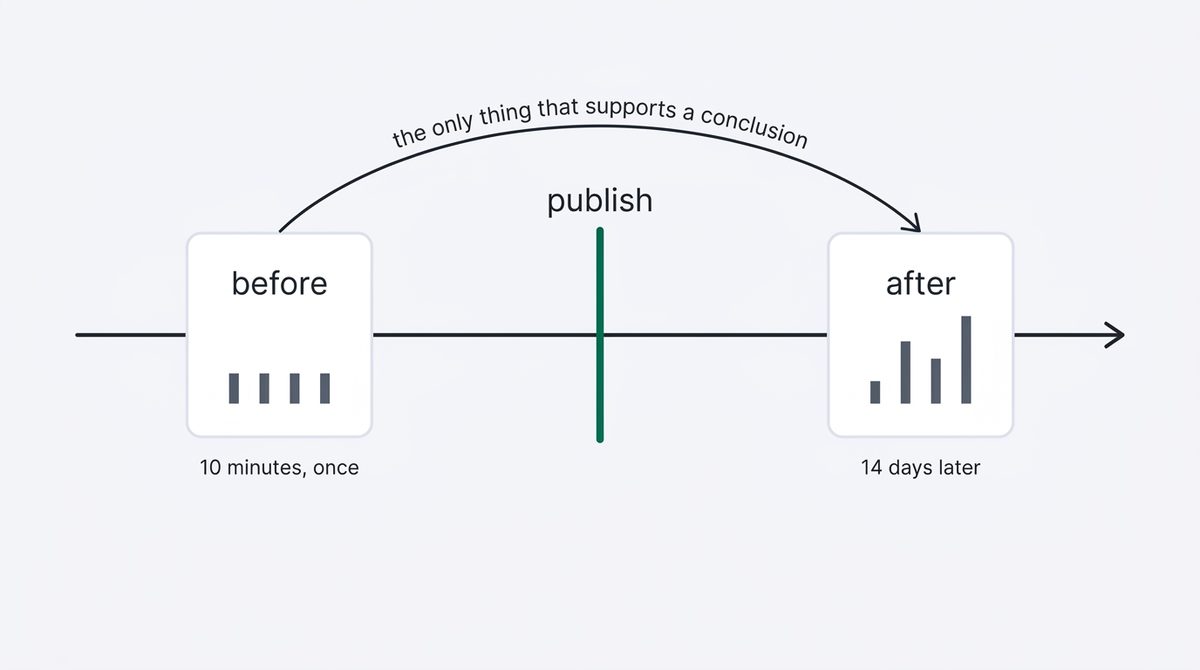
Record your baseline before you change anything, because the last step of this handbook asks whether the change worked — and that question has no answer without a before. It takes about ten minutes, it is the only step here that produces nothing you can see, and skipping it quietly wastes every measurement you take later.
Read this first
Do this after you have picked the page and the search term with striking distance keywords in Search Console, and before you touch a word. Once the page changes, the before is gone: Search Console will keep showing numbers, but you will no longer know which ones belong to the old version.
Why you record your baseline before you change anything
Search rankings move on their own. Competitors publish, Google updates, seasons change, a link appears. Two weeks after a rewrite your numbers will be different whether or not your rewrite did anything, and without a recorded before you have no way to separate the two.
Without a before, "it went up" and "it would have gone up anyway" look identical.
The five things to record
All five come from tools you already have. Nothing here needs an account you do not have or a product you have not bought.
| # | Record | Where from |
|---|---|---|
| 1 | Clicks, impressions, CTR, average position for the target term, last 3 months | Search Console, Performance, filtered to that one term |
| 2 | The same four numbers for the whole page, all terms | Search Console, Pages tab, filtered to that URL |
| 3 | The raw HTML the crawler receives, saved to a file | One curl, see below |
| 4 | The exact date and time you publish the change | Write it down. This becomes your dividing line. |
| 5 | Whether the page is cited today, for 3–5 fixed prompts | Ask the engines yourself and save the answers |
Row 5 is the one people skip, and it is the only record of the AI side you will ever have for the before period. There is no historical report you can go back and pull.
The command for row 3
This saves what a crawler actually receives, not what your browser renders, and counts the readable characters so you can compare after.
URL="https://example.com/your-page"
DATE=$(date +%Y%m%d)

curl -s -A "Mozilla/5.0 (compatible; OAI-SearchBot/1.4; +https://openai.com/searchbot)" \
  "$URL" -o "baseline-$DATE.html"

wc -c "baseline-$DATE.html"
Keep the file. When you re-run this after the rewrite, a byte count that barely moved while the page visibly changed means your content is being added by the browser and the crawler never saw it.
The one you cannot reconstruct later
Rows 1 and 2 can be recovered. Search Console keeps months of history, so if you forget them today you can still pull the before next week. Rows 3 and 5 cannot. Nobody archives what your HTML looked like on a given morning, and no engine publishes a log of whether it cited you last Tuesday.
So if you are going to skip something because you are in a hurry, skip nothing — but know that skipping the crawler snapshot and the prompt run is the version that cannot be undone. Those two take about four minutes between them.
Where to put it
One folder per page, named for the page and dated. The structure matters less than the rule: the baseline and the later measurement live together, or they will not be compared.
baselines/
  your-page-slug/
    20260815-gsc-term.csv
    20260815-gsc-page.csv
    20260815-baseline.html
    20260815-citations.md
    CHANGED-ON.txt
How long the baseline stays valid
Roughly until something other than you changes the page's situation. A competitor publishing a better answer, a core update, a season turning — any of these make the before less comparable, and none of them announce themselves.
In practice this argues for a short gap between recording and publishing. Record the baseline the same day you make the edit, not two weeks earlier while you think about it. A before taken a month ahead of the change is measuring a different world.
Three ways this goes wrong
All three end the same way: two weeks of waiting that answer nothing.
- Taking a screenshot instead of an export. A screenshot cannot be diffed or recomputed. Export the CSV; it is one click.
- Recording after publishing. Even a few hours late and the numbers are already contaminated. If you have already published, wait and treat the next change as your experiment.
- Skipping row 5 because it feels unscientific. It is unscientific — a handful of prompts is not a measurement of anything general. It is still the only before you will have, and later you will be very glad it exists.
Common questions
Is 3 months the right window?
It is Search Console's default view and it is long enough to smooth out weekly noise. Use longer if your traffic is seasonal, but keep whatever you pick identical when you measure again — comparing a 3-month before with a 1-month after tells you nothing.
What if the page has almost no data?
Record it anyway, and note that it is thin. A baseline of near-zero is a perfectly good baseline; it just means you will need a bigger effect before you can claim anything.
Do I need to do this for every page I touch?
No. Do it for pages where you intend to draw a conclusion. Fixing an obvious typo does not need an experiment around it.
Next step
The before is on disk and dated. Now the page can be changed — and because the baseline exists, the change can be a deliberate edit with a hypothesis rather than a general tidy-up.
Recording the before is the cheap part. Making the change, publishing it and pushing the update for indexing is where most sites stall.
Part of the QueryWin handbook · Level 1